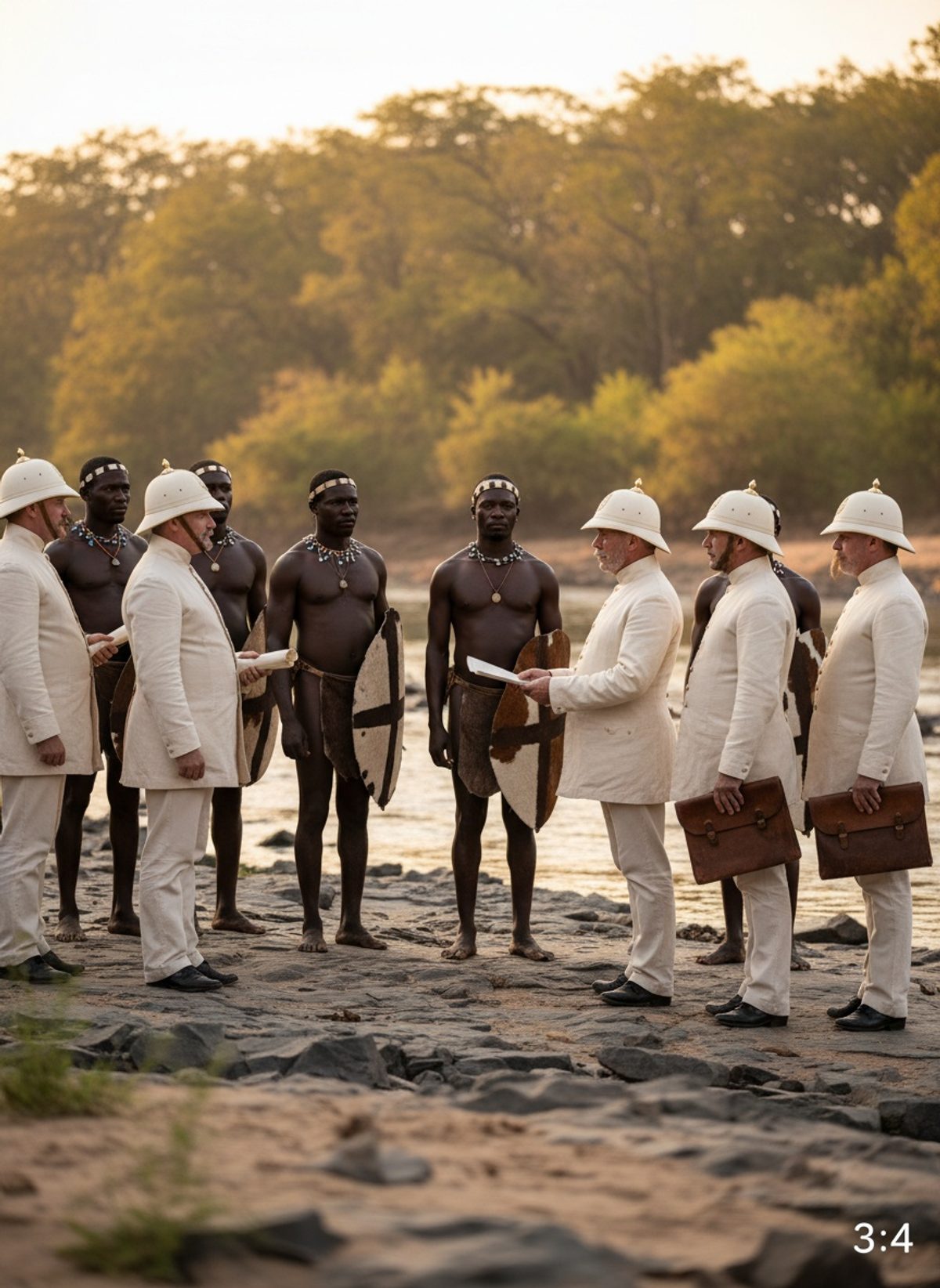
December 1878. The sun blazed unforgivingly above the Thukela River, its waters snaking lazily through a land on the verge of conflict.
The Edge of Empire: A Precarious Peace
The banks of the Thukela River stood as a formidable divide between two worlds on a collision course. To the northwest lay the British Colony of Natal and the ambitions of an expanding Empire. To the southeast sprawled Zululand, a kingdom fiercely proud and resolutely independent. In December of 1878, this frontier was the setting for a confrontation that would ripple through their histories.
For over a decade, the British had observed the disciplined might of the Zulu nation with both admiration and an eye toward subjugation, sensing that their colonial endeavors would never be truly secure while a powerful, organized force remained outside their control. Cetshwayo kaMpande, King of the Zulus, had ascended the throne in 1873, inheriting a militaristic society forged by his uncle, the legendary Shaka. Cetshwayo's reign had maintained the strength of the nation with a well-trained army and a complex social structure that resisted the encroachment of colonial powers.
The Ultimatum: Impossible Demands
The air was tense with history as the Zulu delegation arrived at the appointed meeting with the British commissioners near the Thukela. Among the British demands was the dismantling of the Zulu army, an act that would neuter the kingdom's strength and independence. For Cetshwayo, whose power and legitimacy rested with his military, the ultimatum was not just an affront but an existential threat.
Read next: When Lakshmi Bai Charged the British Line at Gwalior, 1858
The British, represented by the likes of Sir Henry Bartle Frere, the High Commissioner for Southern Africa, saw the ultimatum as a strategic necessity. Britain's imperial ambitions could not accommodate a sovereign military force so close to their territories. Yet, the demands were intentionally impossible. The disbanding of the Zulu military and submission to the Crown sought nothing less than the dismantling of the very fabric of Zulu society.
The Moment of Decision: Cetshwayo's Resolve
Cetshwayo, son of Mpande, received the message carried by his delegates, understanding fully the weight of what was being required. In his kraal—in the center of Zululand's heart—his decision resonated beyond the mere refusal of foreign domination. He had ascended the throne under the ritualistic whispers of his people, aware that his role was not just that of a leader but as the living symbol of the nation’s indomitable spirit.
To comply would have meant dismantling not just an army, but the very backbone of the Zulu way of life. The king knew that submitting to the terms would strip the Zulu nation of its identity, condemning it to the annals of history as just another chapter closed by imperial ambition. His resolve became the pulse of a people who had long thrived off the strength of their kinship and prowess.
The Inevitable War: Crossing the Rubicon
The refusal was delivered back across the Thukela, and in January 1879, the British began their invasion. For the Zulu warriors, this was not just a defense of their home but a defense of existence. The conflict that erupted became known as the Anglo-Zulu War, marked by epic battles including the famed Zulu victory at Isandlwana, where the discipline and sheer numbers of the Zulu impis stunned the world by annihilating a British column.
However, tragic defeats at battles like Rorke's Drift and the gradual, inexorable advance of British forces eventually overwhelmed the Zulu resistance. Cetshwayo's capture and subsequent exile marked the beginning of the end of the Zulu monarchy’s autonomy. Yet, in the echoes of battle cries and upon blood-stained fields, the Zulu resurgence wrote itself into history.
A Legacy Unbowed: Lessons in Defiance
The crossing of the Thukela by Cetshwayo's messengers and the subsequent war were moments etched in the minds of both victors and vanquished. They embodied a time when an indigenous power stood in valiant defiance against the overwhelming tide of imperial expansion. There are echoes of Zulu resilience and British hubris heard in the struggles of nations today, making the lessons of 1878 ever relevant.
The clash at the Thukela River serves as a reminder that history is often borne from the stubbornness of human spirit to stand firm against impossible odds. Cetshwayo's refusal was more than a rejection of colonial demands; it was an assertion of identity, resilience, and the enduring quest for sovereignty in the face of mighty powers. As such, the story of when Cetshwayo's messenger walked into the lion's den remains a poignant reminder of the costs and courage associated with resistance.