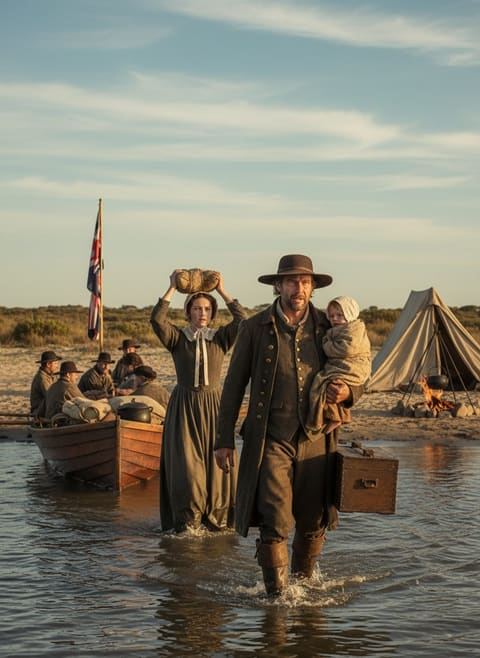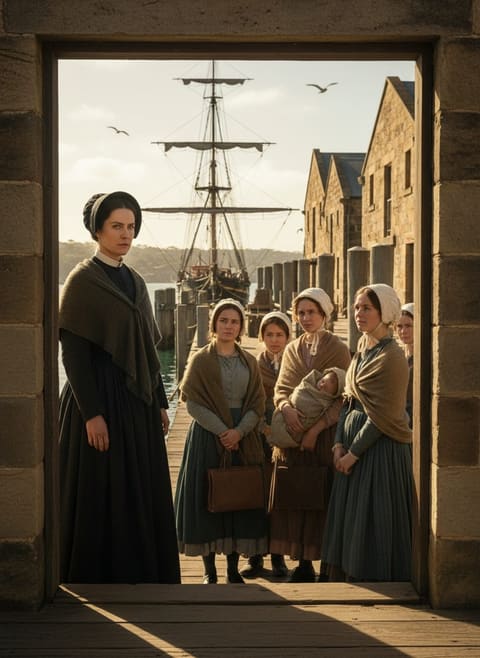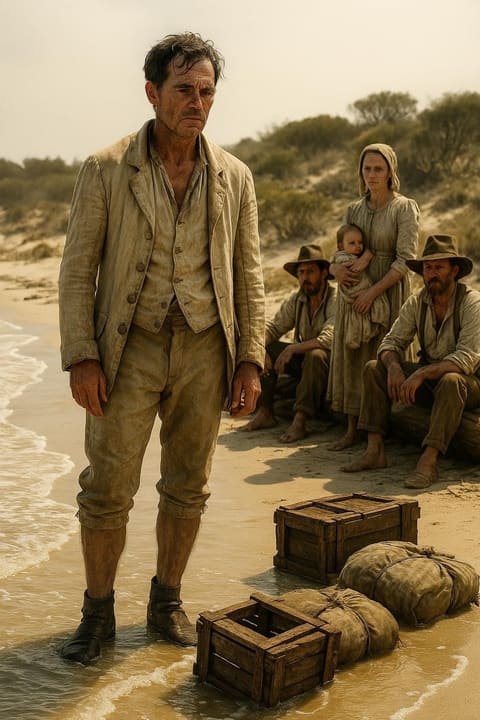
The salty sea spray stung their cheeks as the settlers gazed at the sprawling, untouched landscape of Canterbury, New Zealand. Cloaked in mist and promise, this land was a canvas for the colony dreamt up by a man who had never set foot upon its shores. And yet, the settlers aboard those four ships had committed themselves to transform this alien coast into a vision they carried across oceans, conceived not in the green fields of England but the gray confines of a prison cell.
Visions from Confinement
In the dim light of his narrow, grey-walled cell, Edward Gibbon Wakefield could hear the echoing footsteps of guards and the distant clatter of keys. He was well-acquainted with these sounds, having been imprisoned for the audacious crime of attempting to abduct an heiress. Yet, even as he was physically confined, his mind roamed to vast, unblemished lands far beyond those walls. Wakefield, a man of keen intellect, had formulated a radical idea that would later shape the colonization of South Pacific realms: a perfect society based on an idealized slice of English life.
In Wakefield’s vision, colonization was not merely about expansion but about replication — the creation of a New England in lands unknown. He drafted elaborate plans for an ideal colony, down to the smallest details: a thriving community with a rigid class structure, anchored by the Anglican Church, educational institutions, and agriculture — key elements of Victorian society. He envisioned settlements that would reflect the British sensibilities of order and civility amidst what many saw as the chaos of frontier life.
Wakefield’s idea found fertile ground among the aspirational elite and the Canterbury Association, a group formed with the express purpose of founding a church-centered settlement. They saw potential in Wakefield’s designs, not just for expansion but for demonstrating the superiority of British culture. With his charm and persuasive writings, Wakefield guided them to believe that far-off lands could become more than mere outposts; they could be extensions of England itself, preserved and pure.
Read next: When John Macarthur's Daughter Planted a Garden at Parramatta
The Voyage and the Landing
The journey to New Zealand was long and arduous. Aboard the ships, settlers clung to Wakefield’s promises: vast tracts of arable land and the hope of a new beginning. They were a hand-picked company, chosen for their potential to contribute to a functional and civilized society. Among them were craftsmen, farmers, and professionals, each bringing with them the skill sets necessary to transform untamed wilderness into a bustling, organized township. They carried with them tools, livestock, and above all, the dream of transplanting their way of life halfway across the globe.
When the ships dropped anchor in 1850, the settlers faced the daunting reality of their endeavor. The Canterbury Plains stretched endlessly, unmarked and untamed, a stark counterpoint to the English villages they had left behind. Yet Resilience ran deep in their veins, fired by the conviction of creating a paradise modeled on their distant homeland. Work began quickly; tents rose amid the mud, conversations were held in the open air that laid out the foundations of their future town.
At the heart of Wakefield's dream lay Christchurch, soon to stand as a structure of brick and stone but born of hope and ambition. Slowly, but with the precise structure that Edward Wakefield would have applauded, roads were measured out, churchlands designated, and farms plotted with the certainty that such planning would fend off chaos. Fertile plains meant agriculture could thrive, creating a sustaining backbone for the burgeoning community. They named their fledgling town Christchurch, a testament to the home they left behind and the faith that upheld their mission.
The Making of a "New England"
The settlers faced numerous challenges in their pursuit to create a society as English as if plucked straight from the Midlands. The climatic conditions posed hurdles to their agricultural plans; storms could be relentless, and earthquakes a persistent threat. There were cultural bridges to cross with the indigenous Maori populace, a complexity that would hover over their ambitions, occasionally shaking the very foundations of their endeavors harder than any quake.
Read next: When John Macarthur's Merinos Changed a Continent, 1803
Still, progress marched inexorably forward. The settlers were resourceful and adaptable, slowly building homes, churches, and schools even while the realities of colonial life continued to press upon them. As anticipated by Wakefield, these structures did more than provide sanctuary; they established a cultural and social order amid the rugged new world.
In time, Christchurch emerged, not just as a township but as a beacon of English perseverance and culture, complete with cricket grounds, cathedrals, and the distinct sound of hymns punctuating the morning air. Ironically, even with its strict adherence to an English model, the city bore innovations borne of necessity, a peculiar blend reflective of its geographic isolation. Trade, transport, and communication networks developed in unique ways, marking Christchurch not only as a mirror of Britain but a society innovated out of adaptation to its surrounds.
The tale of Christchurch and the settlers of Canterbury defies simple narratives. It's a saga of resilience, of creating the familiar in the face of overwhelming unfamiliarity. It was a testament to human determination, fueled by aspiration and colored by personal dreams and collective visions. Wakefield's seemingly impossible imagining had manifested, not just from ink and paper but from the sheer will of those settlers who embraced a dream in which they'd invested their futures. In their stories, dreams took on weight and form, rising from the mud to become the very essence of a city.