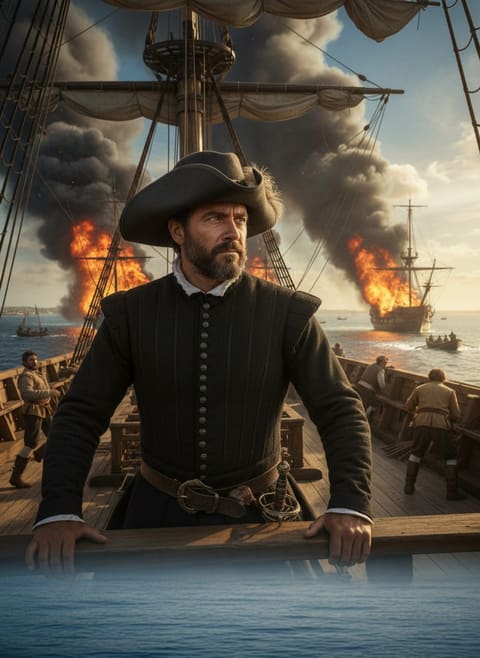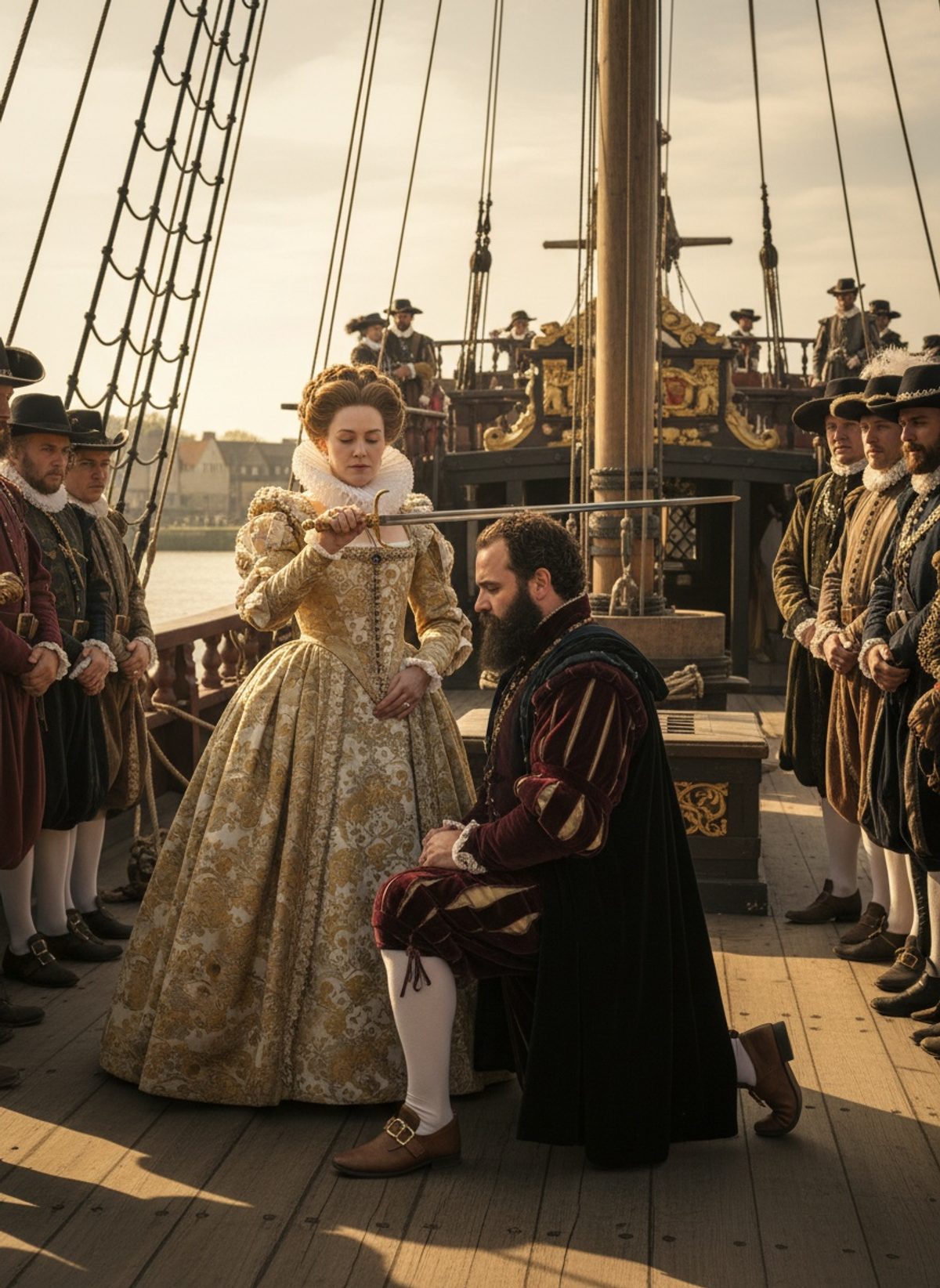
The river Thames lay hushed beneath a rain-drenched sky on that fabled day in April 1581. The air was thick with the smell of the river's brine mingled with the lingering aroma of tar and hemp from the bustling docks. The Golden Hind creaked gently at her moorings in Deptford, her timbers groaning with the weight of treasures untold. The muted clamor of a gathering crowd gave way to silence as Queen Elizabeth I, resplendent in her regal attire, stepped gracefully on board. This moment, as the queen acknowledged the defiance of her nation’s foes by elevating one of her most daring subjects, would reverberate across the annals of maritime history.
The Pirate Turned Knight
The deck of the Golden Hind had been a stage for tales of adventure few could imagine. Francis Drake, the man whose very name ignited fear in the hearts of Spain, stood before his queen. Clad in the attire of a courtier, Drake presented a contradiction—a seasoned sailor transformed into the embodiment of English valor. Spain had cried out for his execution, branding him a pirate of the highest order, a marauder who laid waste to their fortress vaults and fled with their gold. Yet, in England, he was a national hero, a man whose daring circumnavigation of the globe had crowned him with glory and filled the coffers of his queen with unimaginable riches.
Drake had departed Plymouth in December 1577 aboard what was then named the Pelican. Three years later, having sailed through perilous oceans and engaged in battles along unknown coasts, he returned aboard the rechristened Golden Hind with spoils that exceeded the annual income of his monarch. This voyage was not merely one of exploration; it was a profound statement of English gumption and resolve. With little more than courage and cunning, Drake had challenged the Spanish monopoly over the New World and established England’s burgeoning maritime dominance.
A Sovereign Gesture
The knighthood bestowed upon Drake was more than mere ceremony—it was a declaration of war by other means. As Sir Francis Drake knelt before her, the queen raised a gilded sword, its blade catching the pallid sunlight that struggled through the clouds. Rumor has it that the sword belonged to the French ambassador, a diplomatic flourish indicating to Europe that England’s ambition could no longer be contained. This act was not just a commendation of audacity but also a political gambit, an open affront to King Philip II of Spain.
Read next: When Hugh Willoughby Sailed Into the Arctic and Never Came Back
By knighting Drake aboard his very ship, Elizabeth was sending an unequivocal message: England would not bend to Spain's will. The queen’s decision not to bow to pressure, to refuse any notion of Drake’s extradition, symbolized a burgeoning sense of national identity and international defiance. It was a foreboding omen of the struggles that lay ahead between the two mighty maritime powers.
The Sea's Dominion
With his new title, Sir Francis Drake embodied England’s hunger for empire. His expeditions had shown that the oceans belonged as much to those daring enough to chart them as to those who claimed dominion by treaty. The sea lanes, once controlled by Spanish galleons, became host to English privateers who carried letters of marque, license to pilfer granted by the Crown.
Read next: When Francis Drake Knelt in a Stolen Ship, 1580
The knighting of Drake symbolized a pivot towards a policy of calculated piracy, where English adventurers sailed under the royal banner. Drake's voyages, celebrated and mythologized, ignited further ventures that would eventually lead to an empire upon which the sun never set. The echoes of clashing steel and billowing sails were heard across continents as England began its ascent upon the global stage, with Drake's legacy as its harbinger.
The Legacy of a Bold Gesture
The chill of that April day has long since faded into history, but the impact of the events on the deck of the Golden Hind continue to ripple through time. As England galvanized its navy and commerce, it transformed into a powerhouse of innovation and imperial ambition. The knighting of Francis Drake marks not just the affirmation of a hero’s deeds but a pivotal moment of evolution for a nation poised to command the waves.
In the fierce glare of international rivalry, this decisive act of royal endorsement carried the weight of national destiny and pride. Elizabeth's assertive stamp of approval on Drake’s exploits signaled the dawn of a maritime empire. In raising her sword, she did not merely create a knight; she invoked a legacy of exploration, conquest, and dominion. The tales of the Golden Hind tell of a visionary era, where the aspirations of a nation set forth on a tide of audacious seafaring enterprise—a chapter of history that resonates with the daring echoes of "the legends they left out of the textbooks."