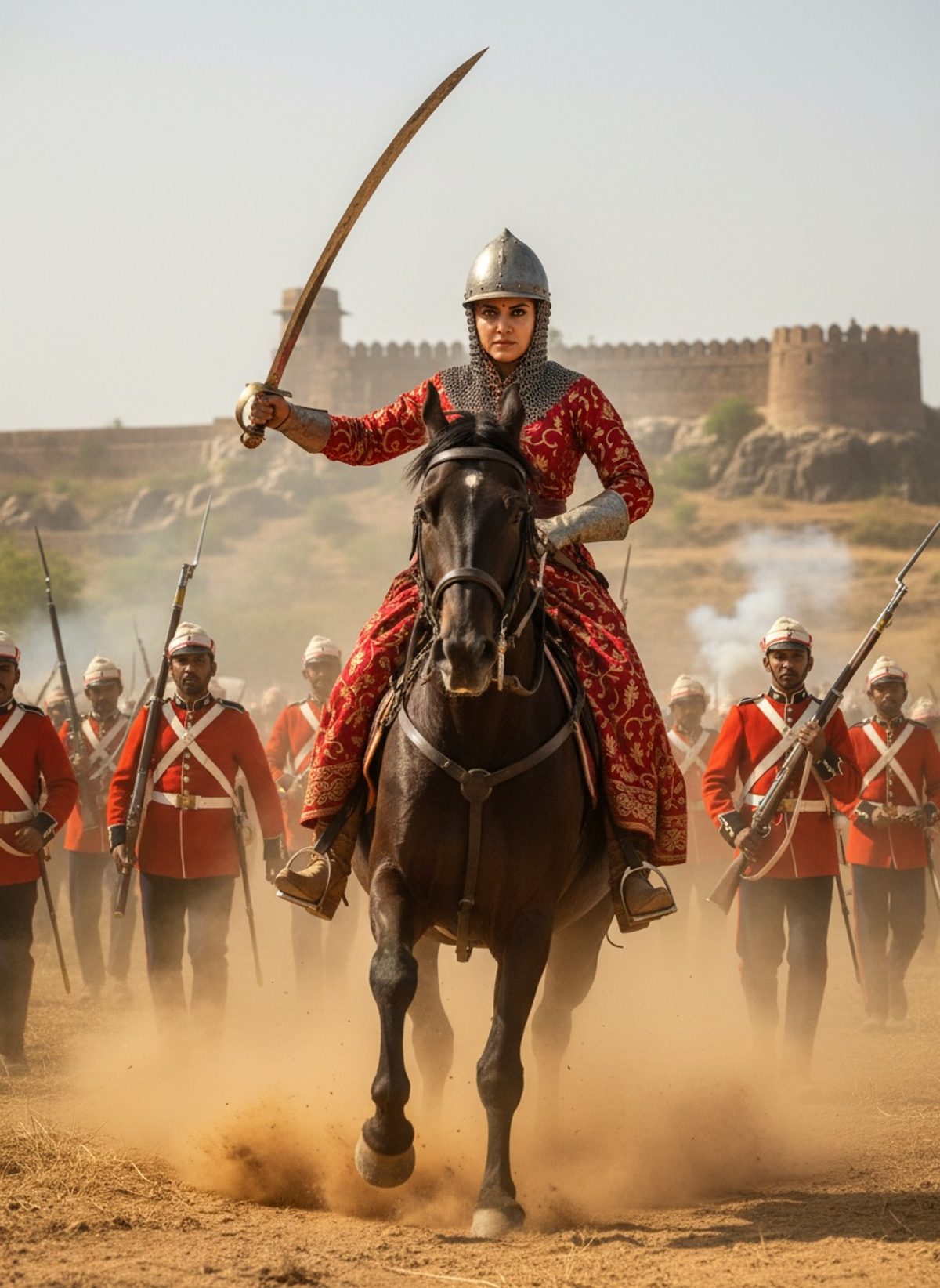
She was only 29 years old. Yet she commanded an army that stirred the entire British Empire.
The Iron-Walled Woman
In the vast panorama of Indian history, the figure of Lakshmi Bai, the Rani of Jhansi, stands apart—an iron-willed woman in a man's world. Born into a Marathi Brahmin family, she transitioned from a poised young girl named Manikarnika to the formidable queen who defied the mightiest forces of her time. The British, with their traditionalist lens, might have dismissed her as just a woman, but Lakshmi Bai transformed this perception as she gathered her strength for a rebellion that would ripple across the ages.
Her rise from the confines of court life to fierce leadership began with profound loss: her husband’s death left her a widow thrust into turmoil, with the annexation of her kingdom looming under the doctrine of lapse. But Lakshmi Bai chose not merely to react—she acted, masterminding the defense of her homeland with such brilliance that even the greatest generals of her time took note. For those within the fortress walls, she was more than a ruler; she was the embodiment of their fierce fight for freedom. Yet, outside, she was a formidable challenge to the colonial powers that aimed to quash her spirit.
The Battle for Jhansi
In 1857, the First War of Indian Independence surged through the subcontinent, disrupting British control and inspiring fierce resistance. In this crucible of rebellion, the Rani of Jhansi's name echoed loudest. Her leadership during the Siege of Jhansi has become legend. A tactical genius, she orchestrated the defense with the precision of a seasoned general, displaying an understanding of warfare that few believed possible from a “mere woman.” The British forces, including seasoned officers, struggled to match her strategic foresight.
Read next: When Birsa Munda Led the Jungle Tribes Against the Raj, 1900
Buckingham, a contemporary officer in the British East India Company, may have underestimated her resolve. Hugh Rose's entry into the city in April 1858 was not a mere breach of walls but a testament to a relentless fight. Amidst cannon fire and relentless siegers, the Rani’s resolve only seemed to grow stronger as she directed her forces. Her appearance in battle—a striking figure clad in warrior's attire—was not mere symbolism. It was a blatant challenge to an empire that assumed her sex would be her undoing.
The Fall of Gwalior's Ramparts
By June 1858, after outsmarting yet another British column, Lakshmi Bai regrouped at Gwalior. Her entry into this fortress city marked a critical juncture. Here, she would stage her final stand. Her decision to fight from Gwalior was strategic, showcasing her acumen; though once allied with the British, Gwalior's powerful fortifications made it ideal for both defense and the consolidation of resistance forces.
General Hugh Rose, the formidable adversary, bore with him the implicit command to suppress this fiery rebellion. As June's fiery sun bore down on the stone walls and dust-cloaked roads, the fever of battle swept through both camps. Rose's troops may have outnumbered the defenders, but for each step they took, the Rani countered with tactical precision. Her military movements, swift and evasive, took even her adversaries by surprise at times, revealing once again her unmatched bravery and tactical insight.
The Rani’s Eternal Gallop
Upon the battlements of her final day, with the forces of Rose closing in, the legend of Lakshmi Bai reaches its poignant climax. Unsupported by reinforcements, hers was a last stand of unparalleled courage—yet it was not a battle she could win. Charging into combat, as those who witnessed would recall, she fought with the spirit of an epic hero. Mounted on horseback, her sword flashing against the sun, she became for many the image of indomitable resistance.
Though her body fell on that battlefield of Gwalior, in the hearts of her people, Lakshmi Bai’s spirit rose immortal. Narratives of her bravery echoed beyond the battle, through generations, becoming a resonant symbol of India's enduring struggle against colonial rule. For those who opposed her, even in victory, they carried the indelible mark of having faced a warrior whose legacy refused to bend under their yoke.
The tale of Lakshmi Bai, the Rani of Jhansi, transcends a single battle, embodying the undying flame of a people's fight for sovereignty and self-definition. Her legend might have been left out of colonial textbooks, but on the Indian soil where she fell, her spirit lived on, igniting the fervor of independence movements to come. Her story serves as a stirring reminder that the courage to stand up against seemingly insurmountable odds can redefine history itself.