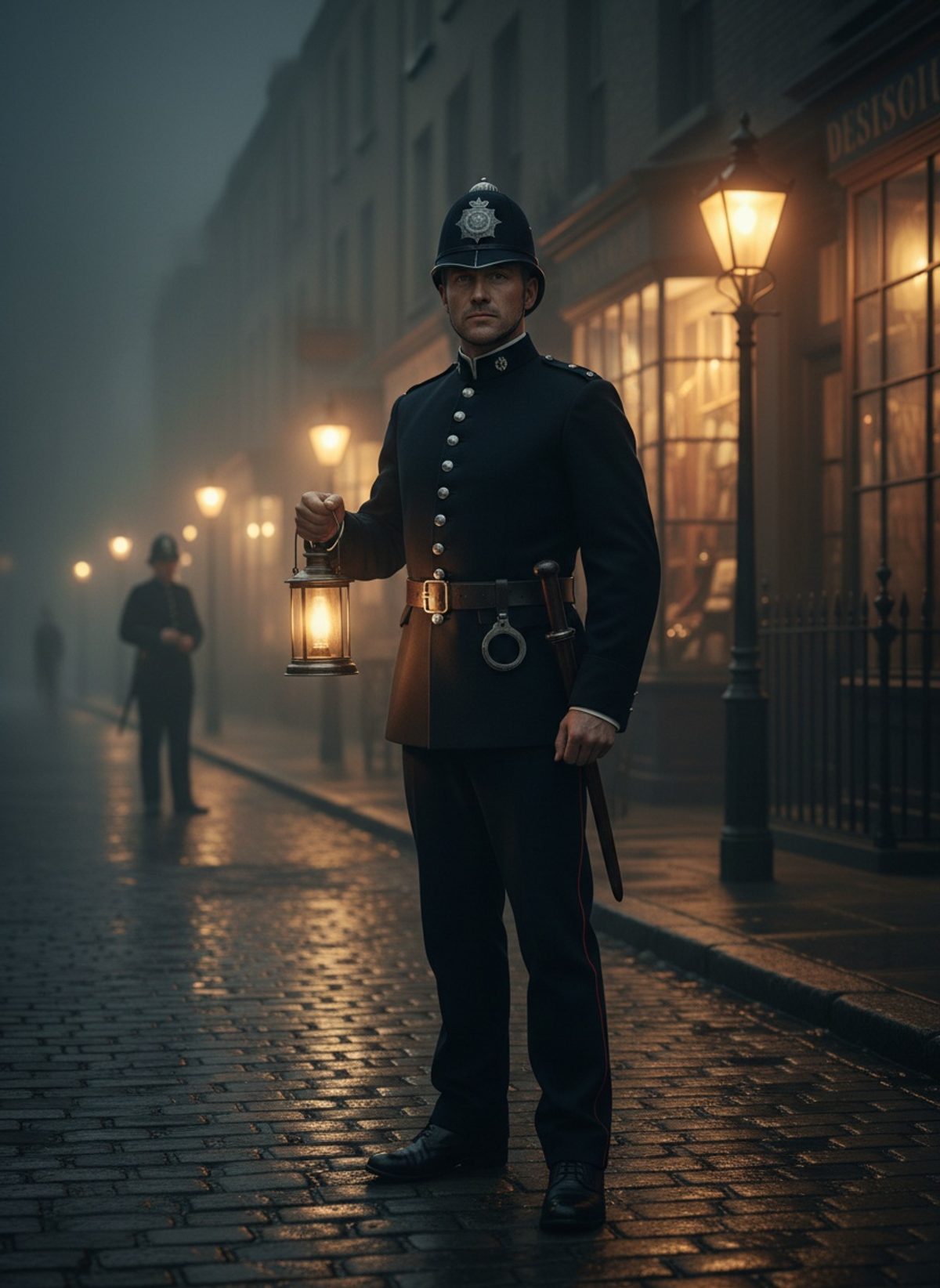
The fog wrapped itself like a ghostly shroud around the streetlamps of London, dimming their meager glow to a flickering whisper. Constable James Wainwright paused amid the swirling smokiness, the crack of a distant carriage wheel echoing off cobblestone streets as he listened intently, his breath forming small bursts of steam in the night air. It was two a.m., the unsleeping city offering the only company on the winding labyrinth of his twelve-mile patrol. He adjusted his collar, absently brushing frost from the edges of his dark blue uniform, thinking as much of the biting cold as of the shadows that held secrets no prudent man dared to unravel.
A Code of Iron: Duty and Discipline
To be a Metropolitan Police constable in 1880 London was to live a life forged in discipline, a life where constancy was law. With a path marked by Victorian rigor, these men were the embodiment of order—a critical bastion against the chaos lurking within the narrow streets and overcrowded slums. They were paid a modest eighteen shillings a week, a sum that scarcely seemed compensation enough for the solitary commitment demanded six nights out of seven, yet it called forth men of singular dedication.
The rules were clear and merciless: appearance was paramount. A good constable was to be impeccably groomed and sober at all times. The guilty whispers of dishonesty or the treacherous sway of intoxication were sins against the civic trust they embodied. Dismissal was the unyielding consequence, as their steadfast integrity was a foundation upon which public confidence rested. This was the age of discipline, discipline that cast an ironclad demeanor over the hearts and minds of the officers who roamed the night.
The Nightly Veil: Navigating London's Shadows
London of the Victorian Empire was a city of contrasts—a luminous beacon of progress by day; by night, it became a theater of darkened alleyways and cryptic figures, each corner draped in enigma. The famous London fog could roll in suddenly, a vaporous haunter befuddling even the most familiar of roads. Yet the constables, armed only with their truncheons and the authoritative echo of their boots on pavement, continued their vigil without the modern conveniences of radios or automobiles.
Read next: When the Empire's Children Wrote Home From Boarding School
In the absence of immediate backup, each officer stood alone against the sprawling metropolis, a blue-coated sentinel steadying the delicate balance between chaos and control. It took a stern heart to confront the night with conviction; the silence of an empty street could be as menacing as any human adversary. Yet amid the tension lay moments of fleeting beauty: the sound of the Thames gently lapping against the riverbanks, or the ephemeral glance of a gaslight casting a circle of warmth upon the frost-kissed ground.
Unsung Men of Steel: Stories Behind the Badges
While the official records trace a broad outline of this era's policing methods, it's the personal tales spun within the realm of the constabulary that breathe life into history. An unassuming constable might fend off a street gang with little more than a look of steely determination and measured words spoken without the need to draw his baton. These men trained themselves to read the pulse of their neighborhoods, knowing the stories of those who walked their streets as intimately as a scribe reading sacred text.
There is the story of one constable who encountered a notorious pickpocket, a lad known for his light fingers and swifter feet. Rather than giving chase into the night, he spent weeks earning the youngster’s trust before offering him a chance at redemption by joining a local boxing club. This, more than any immediate reprimand, was a quietly transformative act—ushering a young life toward honest independence.
The Price and the Reputation of Service
To be a member of the Metropolitan Police in Victorian London was to inhabit a duality. By daylight, these men blended into the vivid tapestry of city life, figures as constant as the rising sun. But come night, they transformed into stoic guardians, mute witnesses to the vast activity percolating through London’s core. Such roles demanded an unyielding mettle, and a lifestyle where personal sacrifice blended with profound public service.
The standards held by the Metropolitan Police during this era helped sculpt the relationship between the force and those they were sworn to protect. By maintaining a steadfast presence within the tumultuous streets, constables garnered a rare respect tempered with reliance, a testament to the resolve they steadfastly embodied. In an ever-accelerating world, their quiet fortitude becomes an enduring reminder of the foundational principles that safeguard our sense of order amidst inevitable change.
The constables of 1880's London might have walked their beats in an age distant from our own, yet the tenacity and bravery they displayed extend across time, influencing public service ideals that persist into the modern era. Their presence amid London's twisting streets tells a story not merely of duty, but one of enduring human will, reflecting an unswerving commitment we perhaps aspire to uphold even today.