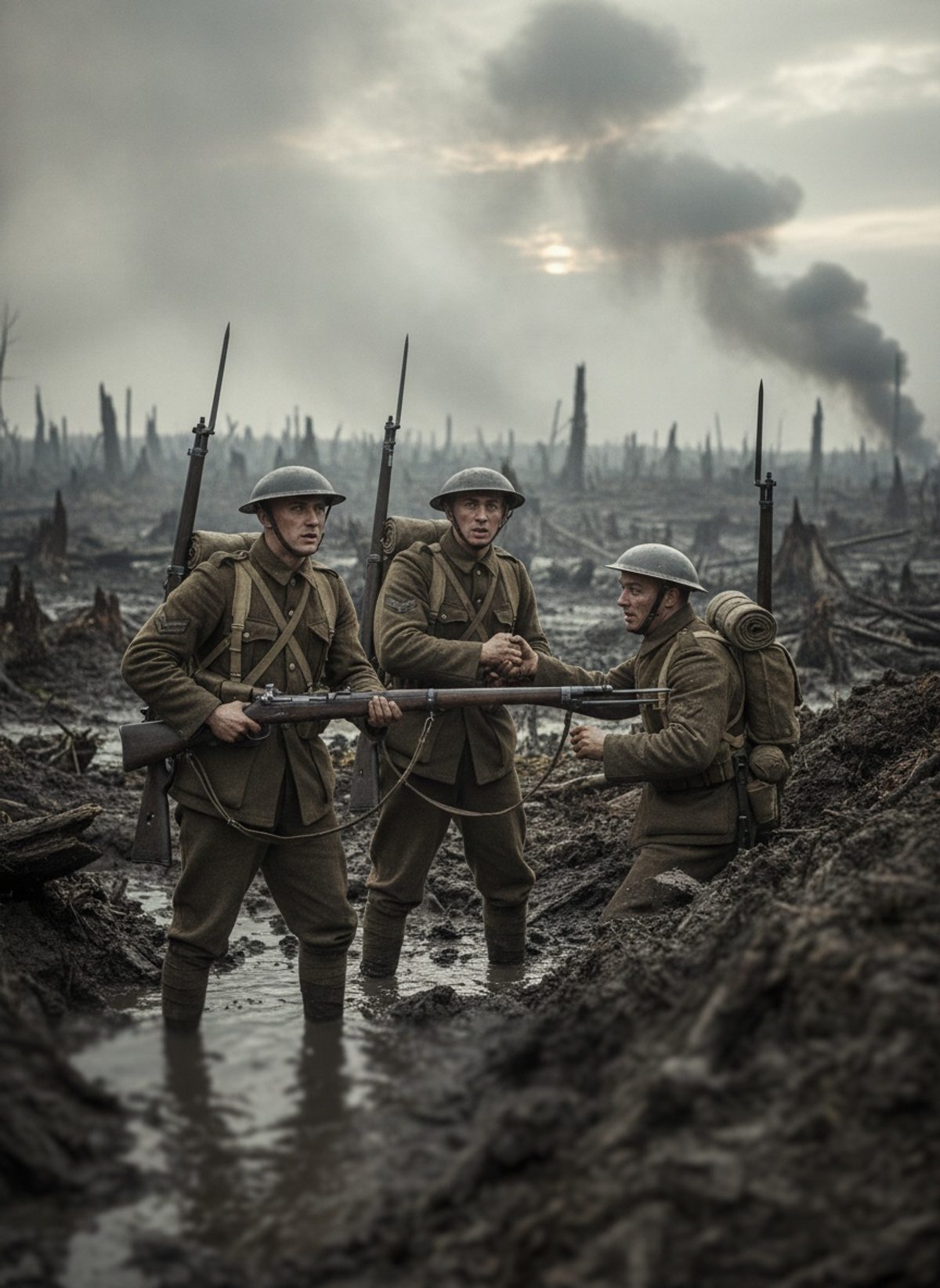
A heavy mist clings to the trees of Polygon Wood, the damp ground molded by the footsteps of countless soldiers who walked these paths long before. The early morning light struggles to penetrate the dense canopy, casting eerie shadows on the forest floor. It's here, amidst the serene beauty of Ypres Salient, that a fierce and bloody battle took place more than a century ago. This once-peaceful woodland had become a chaotic theater of war, consuming men in mud and turmoil during the Battle of Passchendaele in 1917. Beneath the tranquil landscape lies a secret—the remains of soldiers swallowed by the earth, their names and stories lost to time. But decades later, a determined team of forensic historians and DNA scientists embarked on a quest to recover not only their bones but their identities.
The Lost Souls of Polygon Wood
Polygon Wood was part of a much larger strategic push by the Allied forces during World War I, known as the Third Battle of Ypres or the Battle of Passchendaele. Amidst the relentless bombardment and the torrents of rain that turned the battlefield into a morass, thousands of men perished. The wood itself, once thick with oaks and pines, was reduced to splinters and craters, a haunting landscape of devastation. Soldiers from Commonwealth troops, including the Australian and New Zealand Army Corps, fought valiantly in these hellish conditions. In the aftermath, the maelstrom of mud and shattered earth claimed many who vanished without a trace, listed forevermore among the missing.
For over a hundred years, the identities of those lost in Polygon Wood remained a mystery, their souls interred in mass graves or left scattered beneath the forest's reclamation by nature. Families were left without closure, their loved ones memorialized only as names on distant walls and memorial plaques. Yet, the passing of time would not silence the echoes of their unanswered calls. Fast forward to the late 20th century: the advent of forensic science began to present opportunities unheard of in past eras. Enter a group of dedicated individuals armed with the latest techniques in DNA analysis and battlefield archaeology, determined to bring honor to those who had been long forgotten.
Deciphering the Past
Modern science and meticulous historical research became the keys to unlocking the past. Forensic historians and scientists painstakingly began sifting through surviving war records, examining every detail, every clue left behind by the war's vast and tumultuous paperwork trail. Regimental diaries pointed to areas where battles were fiercest, allowing teams to coordinate archaeological digs with pinpoint accuracy.
Read next: When Wideawake Became the Busiest Airport in the World, 1982
In one area of excavation, a small, inconspicuous metal disc surfaced—an identity tag, its letters encrusted and barely legible. Every artifact uncovered was analyzed for its potential to tell a part of the story. Meticulously preserved war graves and contemporary accounts were cross-referenced with newfound data, and the painstaking process of identifying the fallen commenced. In a world where hundreds of men often went unnamed, even the smallest detail—a button, a belt buckle, a fragment of metal—became crucial in piecing together the identities.
Meanwhile, advances in DNA science offered unprecedented capabilities. Family bloodlines were traced through databases, searching for living relatives who could provide DNA samples to match with the recovered remains. It was detective work on a scale not seen before, combining decades-old stories passed down through generations with cutting-edge technology. And as names slowly emerged from the shadows, families scattered across continents began to receive the calls they thought would never come—your ancestor has been found.
Read next: When McLellan Raised His Camera on the Western Front, 1917
Restoring Memory and Meaning
The work of naming the dead of Polygon Wood extended far beyond the realms of science and history—it touched deeply personal narratives of loss and resilience. For families, it became an opportunity to fill generations-long voids. For the descendants of those who fell in October 1917, the return of a lost name was more than just a historical footnote; it was a revival of stories that had teetered on the brink of oblivion.
Restorative ceremonies began taking place, where the bones of soldiers were interred with full military honors. Communities far and wide gathered in recognition of their shared heritage and sacrifice. Though the youngest of World War I's veterans had long since passed, their legacies endured. For survivors' descendants, bringing their lost loved ones home was bittersweet yet profoundly significant, allowing them finally to comprehend personal and collective grief.
Polygon Wood's mist conceals fewer secrets now, thanks to the unwavering quest of war detectives who endeavored to honor the voiceless with identity. As their names rejoin the tapestry of history, another layer is stitched into the quilt of collective memory. The task of recovering those lost amid the churning mud speaks to a larger human desire: the need for recognition, purpose, and closure. In this mission driven by history, science, and familial devotion, the ghosts of 1917 can finally rest, with stories told that had been left out of our textbooks for far too long.