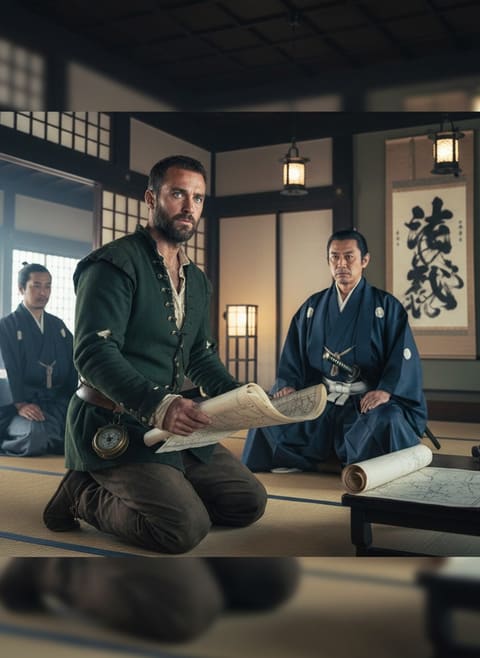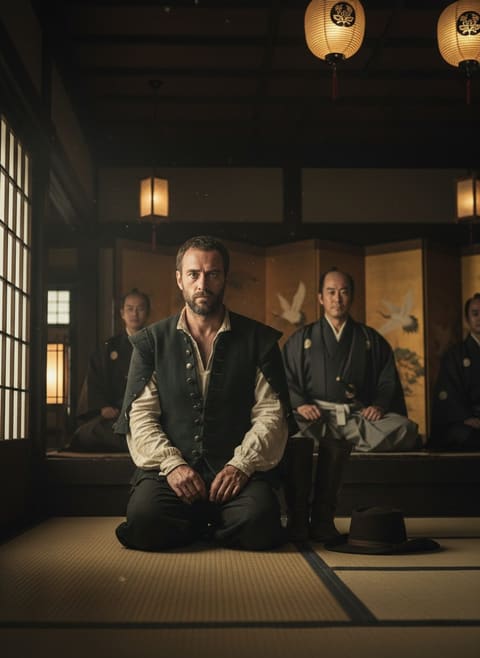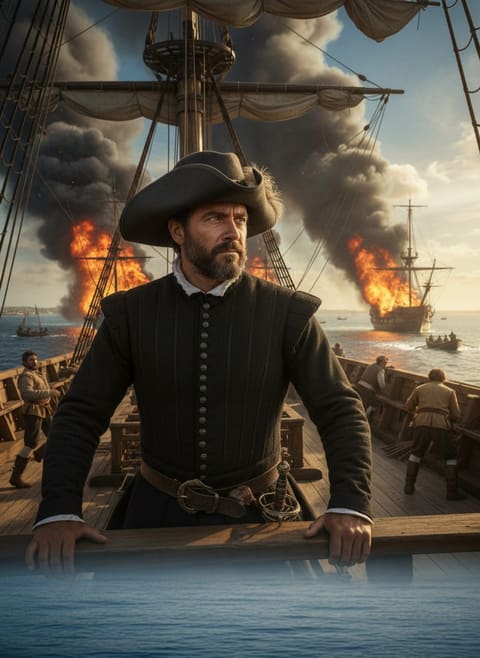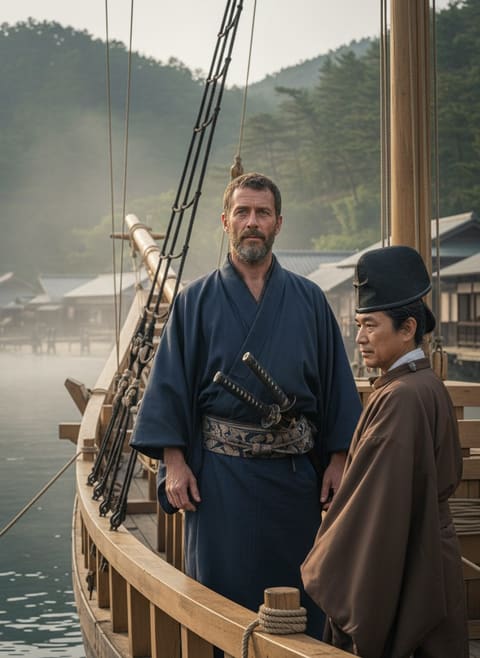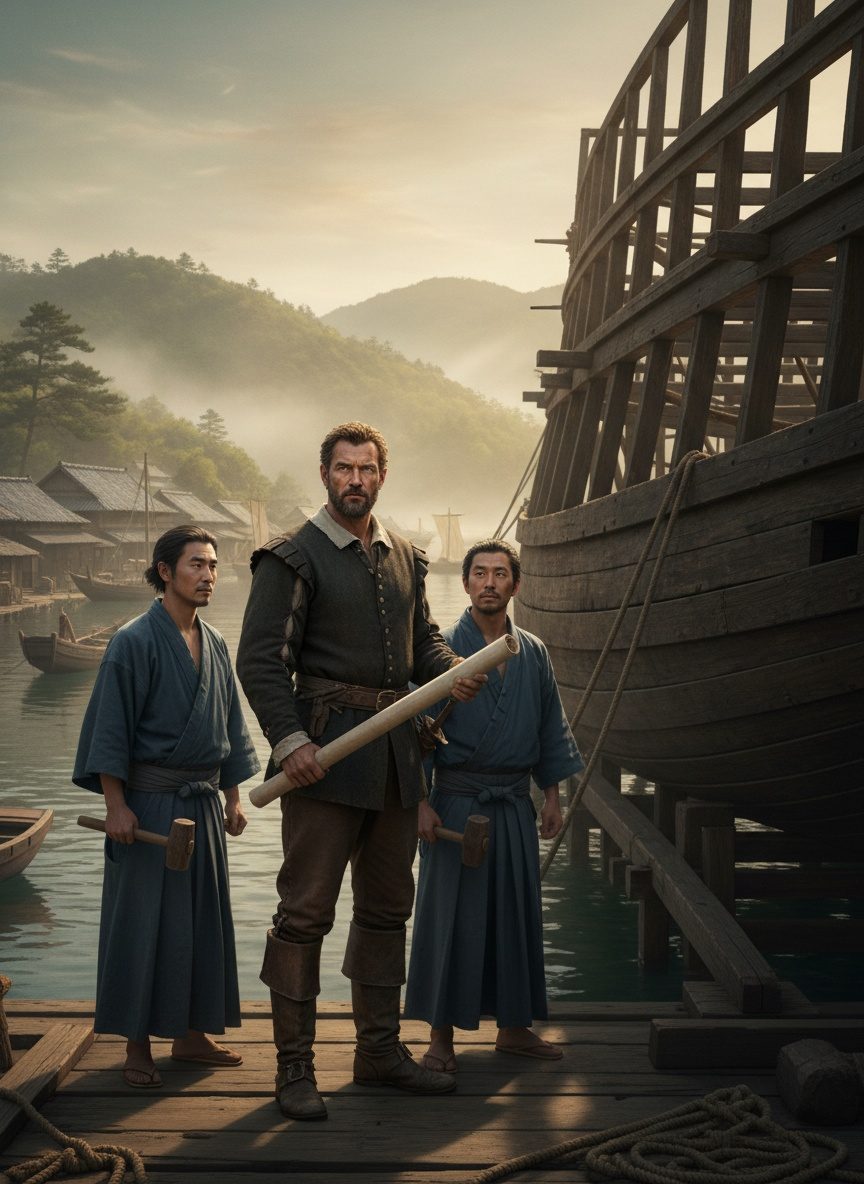
The shores of Kyushu shimmered underneath a midday sun, casting long shadows over the jagged rocks that stood against the gently lapping waves. The air was salty and thick with the cries of seagulls, interwoven with the murmurs of an approaching storm. In the year 1600, this stretch of Japanese coastline became the unlikely witness to a beggarly arrival that would ripple through history: the landing of William Adams, an English pilot who would defy his fate, transforming his foreign misfortune into the remarkable making of a samurai.
The Castaway's Arrival
William Adams was no stranger to America’s rough and unpredictable seas, nor to the complex maelstrom of England's maritime ambitions. As he staggered ashore with what remained of his crew from the Liefde, his vessel of tragedy and fortune, he set foot upon a world unlike any he had imagined. The fabric of his Elizabethan world was being woven with threads from distant shores, new alliances, and unfamiliar tongues. The land he now found himself in—Japan—was etched with the intrigue of the unknown and governed by Tokugawa Ieyasu, a shogun who would come to see more than just a shipwrecked foreigner in Adams’s sea-weathered frame.
In the shadowed halls of the shogun’s domain, Adams faced his destiny with little more than his wits and an extensive, albeit unconventional, array of navigational expertise. Held captive initially under suspicion and curiosity, Adams became an emissary of strange knowledge: a portal into the Western world’s craft and science at a moment when Japan’s own isolationist policies had yet to fully take hold.
The Shogun’s Architect
Tokugawa Ieyasu was a ruler both shrewd and visionary, balancing the internal unification of Japan while casting cautious glances across the seas. With battle-hardened intuition, the shogun saw potential in William Adams to become more than merely a fleeting curiosity. Adams, who had sailed into the wrong ocean, found himself at the helm of a new potential: the builder of Japan’s first Western-style warships.
Read next: When Hugh Willoughby Sailed Into the Arctic and Never Came Back
Adams relied on memory and ingenuity to fulfill his maritime engineering commission. With the task of constructing vessels that could rival European counterparts, he drew on his deep understanding of shipwright craftsmanship—a skill set he transported from the bustling docks of Gillingham to the tranquil yet foreign waters of this eastern empire. With planks of wood and bands of iron, Adams did not merely introduce new technology; he gifted insight into foreign methodologies, entwining them with Japan's own robust nautical traditions.
The Making of Miura Anjin
Beyond diagrams and workshops, Adams’s residence in Japan painted another tapestry: one of cultural integration. Tokugawa, recognizing Adams's loyalty and unmatched maritime acumen, bestowed upon him the title of samurai and the name Miura Anjin, a testament sealed in the annals of history. It was a metamorphosis extraordinary in its depth, turning the castaway pilot into a keystone in the cultural and technological cross-pollination between East and West.
Read next: When Francis Drake Knelt in a Stolen Ship, 1580
In his new guise, Adams garnered admiration and influence, negotiating intricate relationships with both local daimyos and other foreign envoys. He walked the fine line between diplomatic engagement and cultural alienation with intricate precision, his life a constant balancing act between duty to his European roots and allegiance to his adopted homeland. The samurai code—Bushido—became a guiding principle, not just in wielding a sword but in forging connections and understanding between divergent worlds.
The Legacy of a Samurai
William Adams never returned to the green hills of Kent. Instead, he saw a life unfold thousands of miles from his birthplace—a life marked by the soft rustle of kimono-clad courtiers, by the intense gazes of armored samurai, a life ending not as a mere pilot lost to time, but as a uniquely bridged soul between nations.
The story of Adams is a narrative whisper amidst the cacophony of England’s imperial ambitions. His contributions—an Englishman as adviser and ally to the Japanese shogun—echo today as a testament to the enduring nature of cultural exchange, even amidst the backdrop of burgeoning empires. Adams’s journey teaches us of the power and surprise possibilities embodied by human resolve, and how the ripples of one life can expand far beyond expected possibility, connecting continents in their delicate dance through history.