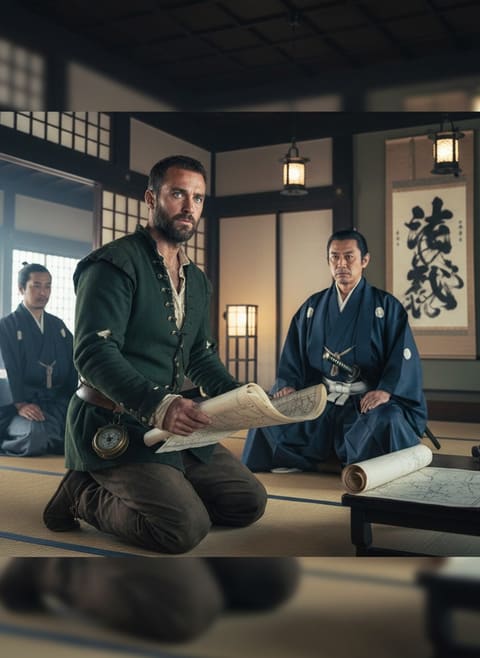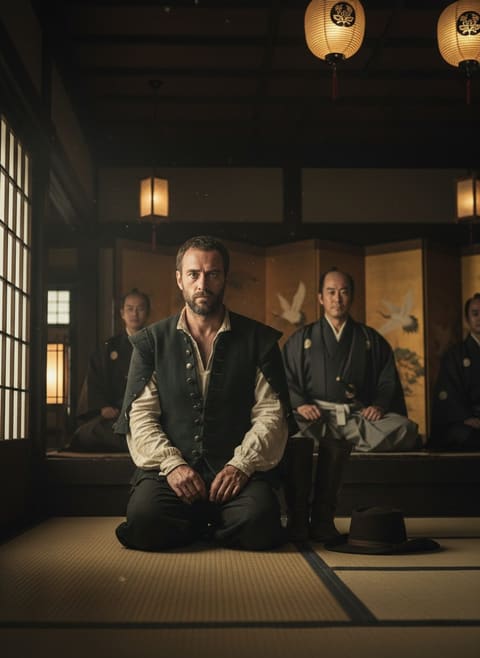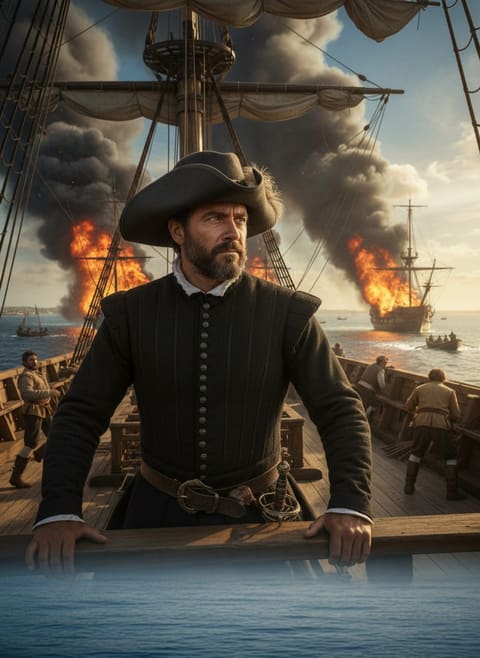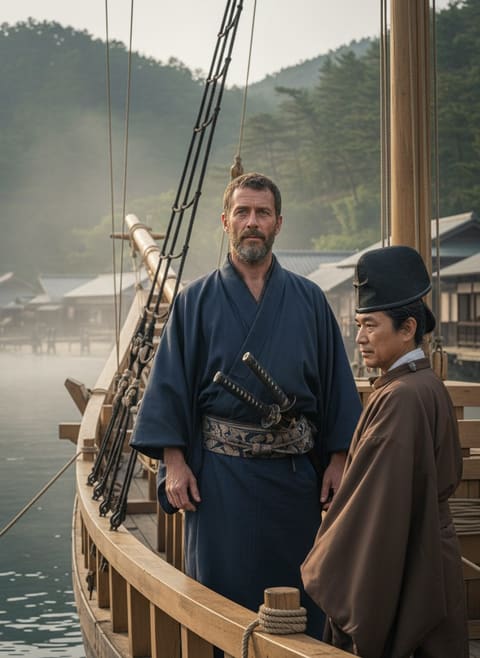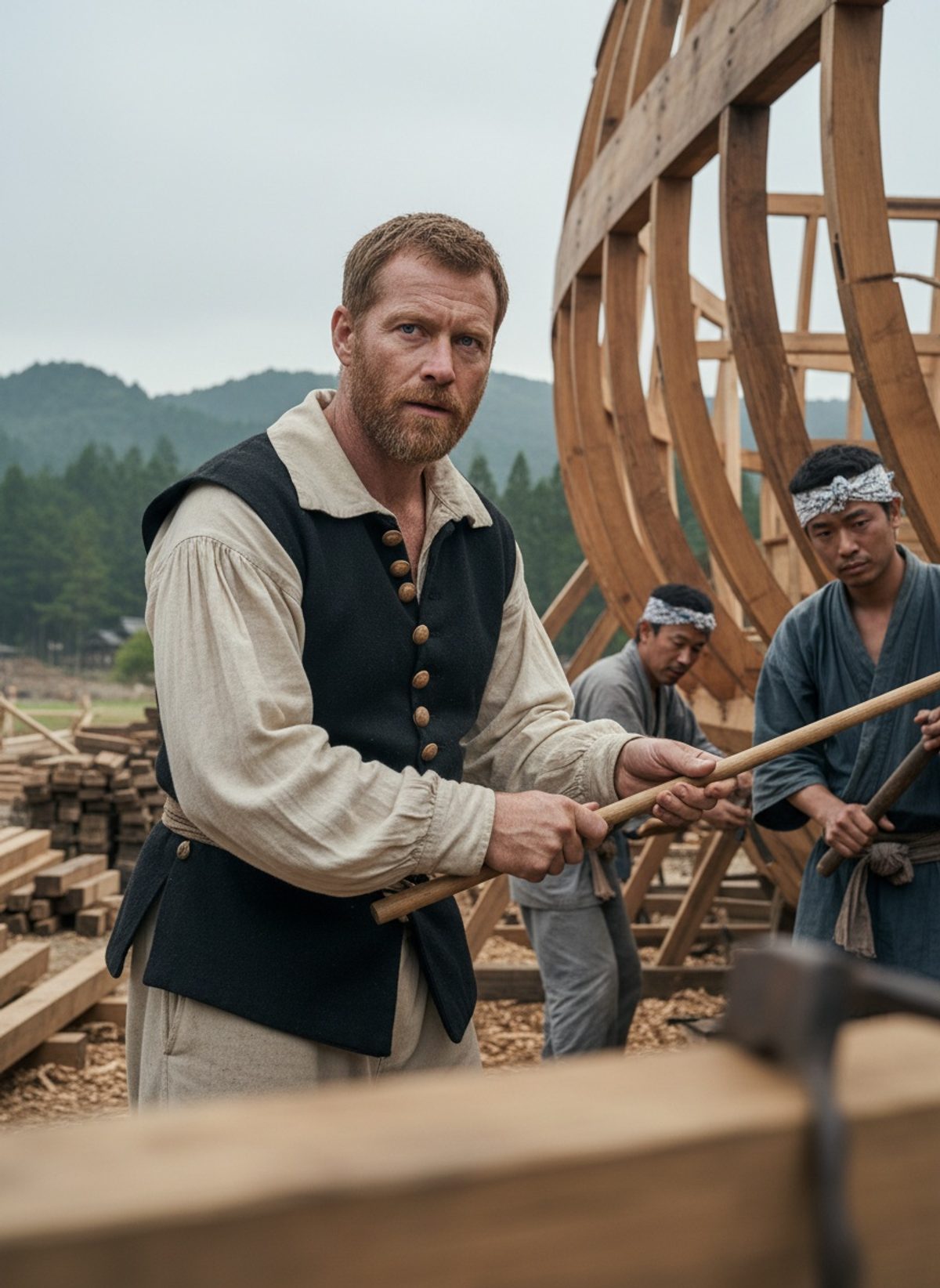
Gentle waves lapped against the wooden supports of the docks at the sprawling shipyard in Edo Bay. The air was thick with the scents of brine and newly hewn timber. The glow of the setting sun painted the waters gold, casting an otherworldly light on the bustling figures moving with purpose across the shipyard. Amidst the sounds of hammers striking nails and the murmur of voices speaking in a language foreign to him, William Adams stood, a lone English sailor, tasked with an almost impossible feat. Here, on this distant shore, where the horizons were punctuated by the jagged peaks of mountains, Adams was about to embark on an endeavor that would challenge the very boundaries of his existence and the wider geopolitical world of 1604.
Just years earlier, Adams had charted an unknown course aboard the Dutch fleet, unknowingly steering toward destiny. Shipwrecked and half-dead, he had washed ashore in Japan after a harrowing journey. For many, Japan was a forbidden land, shrouded in mystery and myth, known to most Europeans only through hearsay, as a realm with more legends than truths. Yet here he was, at the mercy of a society whose customs were as distant to him as the faces of the people. Adams found himself enmeshed in a complex web of foreign politics. The European powers clamored for his execution, fearing what knowledge he might impart. But fate had charted a different course for him.
The man who held his life in balance was Tokugawa Ieyasu, a powerful daimyo on the precipice of unifying Japan under his shogunate rule. Astutely aware of the world beyond his shores, Ieyasu saw in Adams not just a novelty nor a threat, but an opportunity—an entry into the fierce realms of naval warfare and international trade that were redefining the edges of the known world. In Adams, he saw what no one else did: a master of the West's most jealously guarded secrets, skilled in the design and construction of advanced ships. Under Ieyasu's gaze, William Adams transformed from a prisoner into a pivotal figure in Japan’s rise to power, and what Adams built would ripple across the seas.
The undertaking was nothing less than visionary. Adams was to build Japan's first Western-style warship—something heretofore unseen in these waters. Armed with little more than his vast knowledge and an indomitable spirit, Adams set about translating his expertise into reality. The task was daunting: to blend European technology with Japanese craftsmanship. Where Europe had honed shipbuilding into an art driven by the engines of empire, Japan had nurtured its own seafaring traditions, elegant yet fundamentally different. Marrying these approaches required an alchemical result, a new kind of vessel forged in an unprecedented exchange of cultures.
Read next: When Hugh Willoughby Sailed Into the Arctic and Never Came Back
The shipyard thrummed with the energy of ambition and the blending of worlds. Japanese artisans, skilled in the meticulous creation of their sleek and agile vessels, now learned the skeletal grace and robust lines of Western galleons. They watched intently as Adams demonstrated techniques honed in distant lands—methods for calculating the ship’s stability, the meticulous fitting of its hull, and the crafting of its masts to bear the sky-wide sails. Each nail driven, each plank set, carried the legacy of untold seafaring knowledge.
The ship, when it finally took shape, was a marvel of engineering, a proud testament to the potential locked within cultural synthesis. Her frame was sturdy and formidable, more than capable of withstanding the capricious seas that encircled Japan's islands. The labor of many hands—and among them, Adams' guiding touch—had conjured something both strange and familiar. This fusion, a true epic on water, embodied a tangible promise of trade and power. It was far more than a warship; it was a symbol, an anchor binding Japan's past with the winds of the future. The promise of what such a ship could bring was immeasurable—trade, influence, security, and most importantly, a glimpse into a globe-spanning new world.
Across the dock, beneath banners snapping sharply in the breeze, stood Ieyasu himself, watching the ship's great hull ease into her natural element. In that moment, Japan's first Western warship ceased to be simply an object of wood and iron; it became a beacon—a voyage of hope through the mist-shrouded future. The ship's maiden voyage was launched on a tide of eager anticipation, an emblem of formidable change, her sails billowing under the expansive blue of Japan’s skies.
Read next: When Francis Drake Knelt in a Stolen Ship, 1580
For Adams, this monumental task was more than personal redemption or survival. It was a declaration of the heights achievable when worlds intertwined rather than collided. Walking the decks of his creation brought him to the precipice where alienation transformed into acceptance, where knowledge—given freely and shared wisely—built bridges across oceans and cultural divides.
As the ship slipped away from the shore, it carried with her the latent strength of a nation on the cusp of modernity. In the years that followed, Ieyasu's Japan would emerge as a foundational player on the international stage, sovereign yet engaged with the world beyond her seas. And the keels forged in that distant bay would set a precedent for many more to come. The currents and tides of history were forever altered, as the ship William Adams built in 1604 sailed outward to meet the world.
In this new dawn of maritime might, what persisted beyond the salt spray and horizon was succinctly clear: the mutual understanding and trust, bonded by shared knowledge, could sail mankind toward uncharted possibilities. Adams' legacy was not merely wooden beams lashed by sea and wind but was the hidden script in the unfolding play of empires. It was proof that sometimes, the most lasting impact of any era is written not in the laws that govern it, but in the undertakings that reframe its principles. Here, history was being remade, one plank at a time, in the shipyards of a new world at dawn.