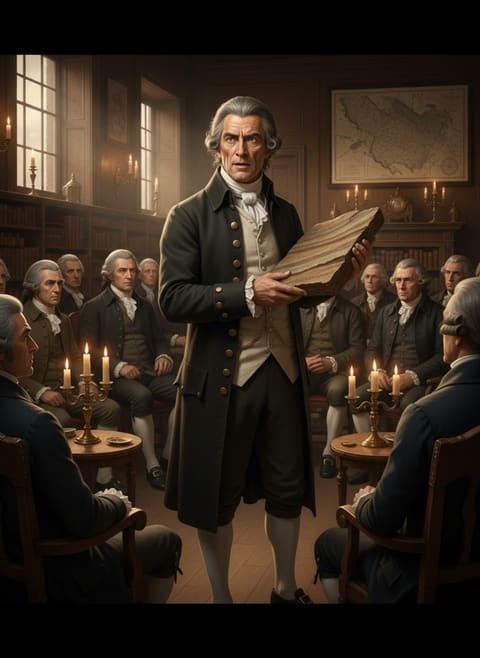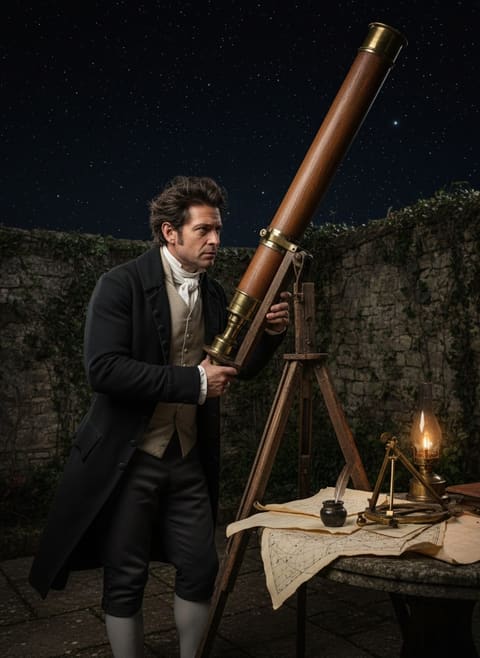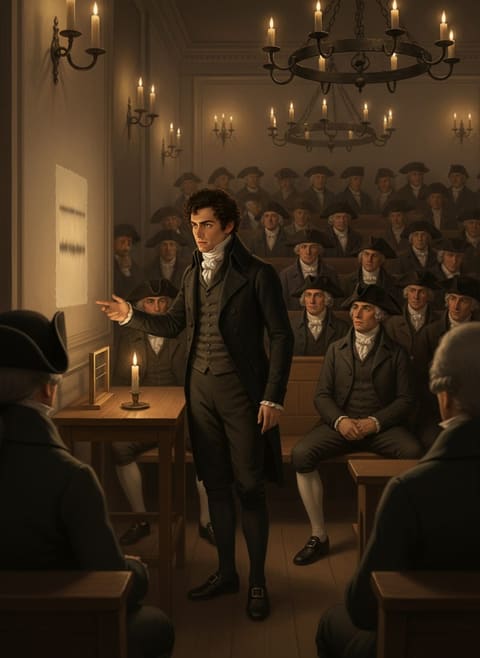
February 24, 1801. A curious hush fell over the chamber, where the intellectual elite of Britain gathered in anticipation at the Royal Society in London.
The illustrious Royal Society, with its timbered ceilings and austere portraits of great minds from the past, seemed an improbable setting for revolution. These were walls steeped in the doctrines of Newton, who had deciphered gravity and declared that light consisted of particles — hard, certain particles that explained the universe with unwavering precision. Few dared to question Newton's wisdom, least of all in his homeland. Yet, on this day, Thomas Young, the son of a humble glassmaker from Somerset, stood ready to unveil what would become one of the most enchanting experiments in the annals of science.
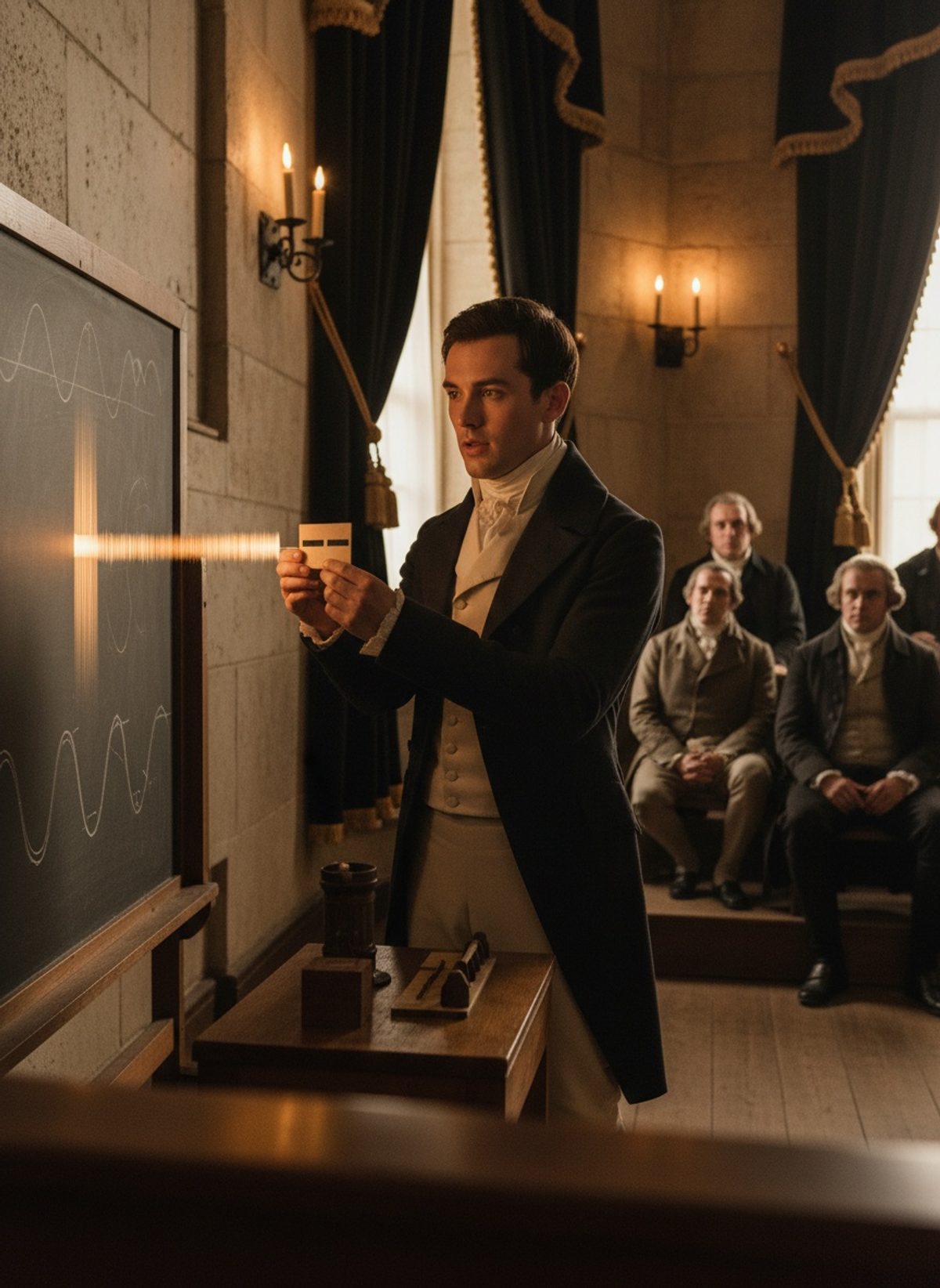
Young, a physician by trade and a polymath by passion, approached the wooden lectern with a quiet confidence. His experiment was simple in design but profound in implications. Before him lay a unique device — a single source of light, a card with two narrow slits side by side, and a screen upon which to watch the dramatics unfold. The audience settled into an expectant silence as Young carefully positioned the source of light, aligning it to shine through the card.
To the gathered scholars and gentlemen, it seemed axiomatic that two narrow slits would yield two streaks of light — straightforward lines, a testament to the corpuscular nature of light as dictated by Sir Isaac Newton. It was a belief older than most of the attendees, a hand-me-down certitude from their textbooks and mentors. But as Young activated his experiment, what appeared on the wall was not two distinct beams but rather a mesmerizing pattern of alternating dark and light fringes, akin to water ripples spreading and overlapping in a serene pond.
Read next: The Day a Joiner's Son Gave the World a New Kind of Light
Thomas Young had discovered the wave nature of light. This interference pattern was a spectacle that defied generations of entrenched Newtonian doctrine, suggesting that light could behave not only as particles but also like waves. This was audacious; it was radical. The dark and bright bands on the wall quietly but powerfully whispered that the era of Newton alone reigning supreme was drawing to a close.
In that historic instant, the room was filled with murmurs of confusion and awe. For the first time, the audience was witnessing evidence of the duality of light, a complexity that Newton's definitive particles could not explain away. It wasn’t so much a refutation of Newton as it was a bold invitation to reimagine and expand what was possible.
Young was no stranger to controversy or complexity. Born to a Quaker family, his upbringing instilled in him a love for learning devoid of frivolity but rich in exploration. He mastered numerous languages, cultivated an understanding of ancient literature, and studied medicine and optics with fervor. His presence before the Royal Society was not just as a challenger to Newton, but as a beacon of Renaissance curiosity modernized for a new age.
Yet, the experiment extended beyond optics into philosophical realms. The behavior of light as waves suggested that beneath the surface of empirical certainty lay an ocean of possibilities — opening a gateway to quantum puzzles that would captivate scientists long after Young was gone. The double-slit experiment unearthed mysteries not just of the physical world but of our perception of reality itself.
Read next: The Day a Blacksmith's Son Mapped the Blood Inside Us
The audience at the Royal Society, though steeped in traditionalism, was not unacquainted with daring inquiries. Britain, in the dawn of the 19th century, was a crucible of innovation. The Industrial Revolution was reconfiguring every facet of society, and here was Thomas Young, navigating change not with steam or steel, but with subtle, piercing intellect.
Resistance was inevitable. The tenacity of older ideas held firm within academic circles, and Young's insights into light's wave nature faced skepticism. Amongst contemporaries, the specter of Newton loomed large, and the faithful clung tightly to the familiar. Yet, scientific discourse thrives on challenge, and Young's ideas seeped into the consciousness of those willing to explore and question.
In time, the groundwork Young laid would prove invaluable. Future titans of physics, such as James Clerk Maxwell and Albert Einstein, would build upon these revelations. Maxwell's equations would eloquently describe how light waves propagate, while Einstein's theories would revisit particles in the guise of photons. These discoveries, rippling outward like the patterns on Young's screen, would lead to a deeper understanding of the electromagnetic spectrum and the very fabric of space-time.
Thomas Young illuminated more than just a screen that day in 1801. He ignited a spark, a call to the intellect to seek beyond accepted perceptions. His experiment stands as a timeless testament to the potency of curiosity unfettered. In the corridors of time, where history often favors the grand and dramatic, Young reminds us of the quiet, transformative power of daring to glimpse the world anew through two simple slits.
As we voyage further into the universe's complexity, Young's lesson endures. Science, like the light he studied, rarely travels a solitary path. Instead, it refracts in myriad directions, intertwining waves of discovery with particles of truth. The beauty of science isn't just in what it reveals, but how it insists we continuously challenge and redefine our understanding of reality. That, perhaps, is the true legacy of the glassmaker's son from Somerset — that knowledge, at its essence, is a journey driven by light.