He was no stranger to America, though many think he was. David Hartley had once governed New York before sitting at the negotiating table in Paris.
The Last Days of a Beleaguered Empire
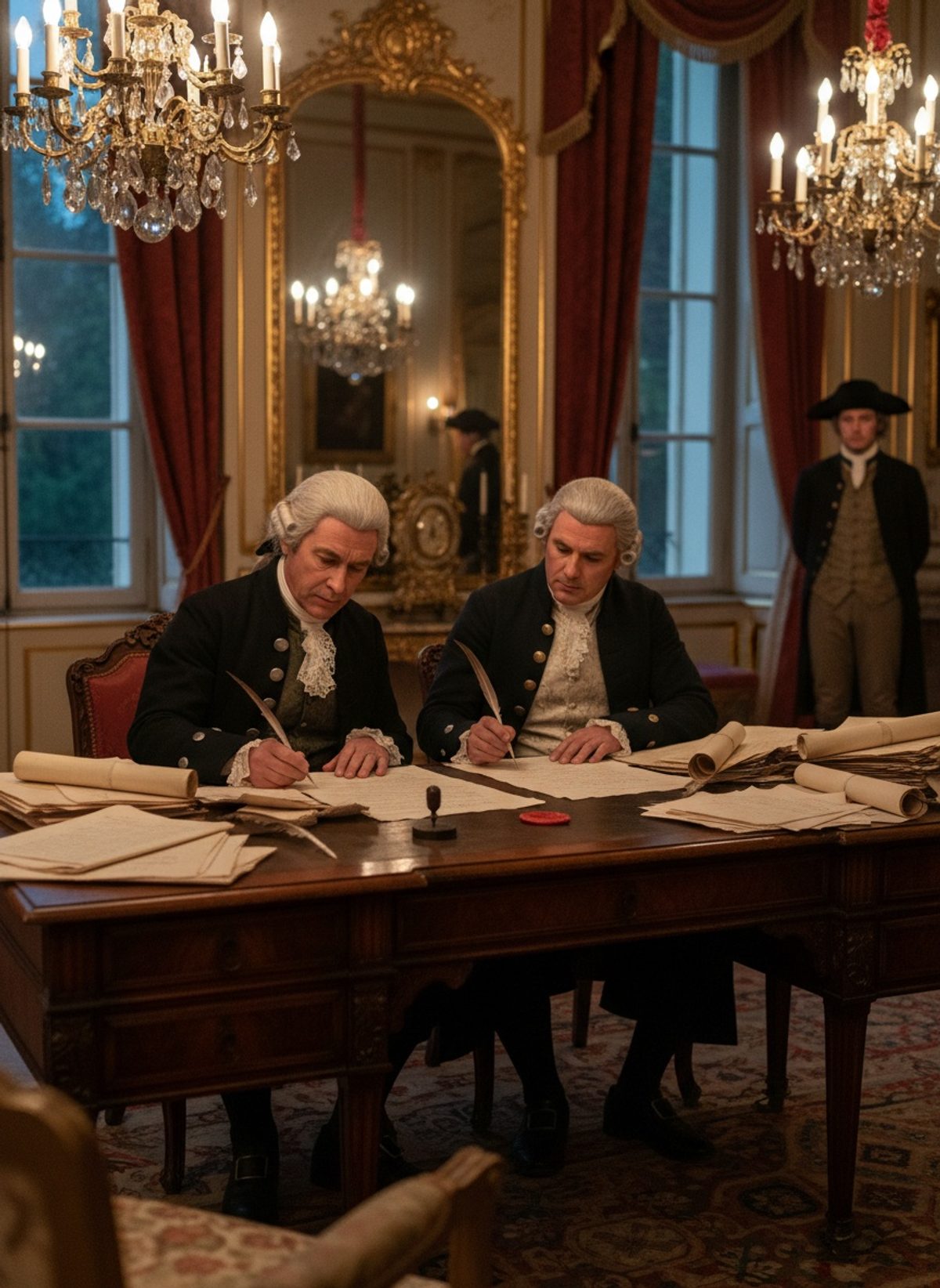
In the cobbled streets of Paris, the air was thick with the weight of history about to unfold. The Treaty of Paris was not just a diplomatic resolution; it marked the end of an era. On September 3, 1783, Britain officially recognized the independence of its former colonies, a moment that seemed unimaginable a decade earlier. For the British, the setting was an alien world of elegant salons far removed from the smoky, crowded meeting rooms of Whitehall. David Hartley, the British signatory, felt the burden of expectation upon his shoulders. Having served as the Governor of New York, he was familiar with the vast, untamed lands across the Atlantic and had once held ambitions for Britain’s colonial prosperity. Yet here he sat, to ink an agreement that would signify Britain’s retreat.
Across from Hartley, Benjamin Franklin and other American diplomats represented a new nation birthed from revolution. Together, these men were engaged not just in formalities but in redefining global power dynamics. The American Revolutionary War’s final chords were composing a melody of endless change, with the last notes struck at the surrender in Yorktown two years prior. It was a conflict that had consumed much of the world in its ramifications, not the least of which was the empire’s expenditure, including forty thousand lives and a financial burden Britain would struggle to repay for generations.
Painting this scene, few picture the personal dynamics at play. The interaction of Hartley and Franklin, cordial yet fraught, was both a farewell and a beginning. This moment encapsulated the dichotomy between old world empires and the daring experiments of the new. While Britain mourned a loss, the Americans saw a dawn. The treaty shook the foundations of traditional power and foreshadowed the tectonic shifts that would shape centuries to come.
Read next: The Night a Surgeon Walked Into Hell and Saved 500 Men
The Ink and What It Meant
The pen in Hartley's hand shifted history one scratch at a time. Yet, it’s easy to overlook the complexity behind his simple act of signing. The Treaty of Paris was a document painstakingly negotiated, a tapestry of interests and concessions. For many British citizens, its signing was a moment stripped of any glory. There was no cheering, no triumphant parades. It was a quiet, sober acknowledgment that an empire had overstretched itself across the seas and faced a growing weariness at home. The burgeoning economic woes exacerbated by the war presented a dim view of what imperial ambition had wrought.
Within the hushed tones of the treaty’s paragraphs lay Britain’s relinquishment of claims to a vast land, where once the sun never set on its dominions. The American signatories, unified yet hailing from diverse states with their unique agendas, saw the treaty laying the groundwork for governance and unity. For America, the document was a scaffold upon which to build a nation, while for Britain, it was a symbol of a hard-fought lesson. Their priorities required a shift in perspective, to maintain influence not through sheer territorial expansion but through diplomacy and economic power.
While this may appear a straightforward tale of loss, Hartley’s actual sentiments were more complex. Having governed in the heart of America, he understood the colonies not just as assets but as burgeoning societies with aspirations and capabilities that might persist independently. Perhaps he contemplated the possibilities as much as he mourned the certainties lost. Years earlier, Hartley had been an advocate for conciliation with the colonies, making this diplomatic dance both a personal reckoning and a public duty.
Echoes of Empire and Independence
As the ink dried on the parchment, echoing silence enveloped the ornate room. The moment was palpable, far-reaching in its repercussions. This was more than a political pivot; it was a shift in the very essence of empires and the blueprint for independence. Where Britain once stood as an indomitable imperial force, it now had to redefine its role in an age swiftly moving beyond mere territorial acquisition. Hartley's withdrawal from the signing table became a gesture marking the end of British America but also the dawn of Britain's impending re-evaluation of its place in a rapidly changing world. Once defined by the breadth of its possessions, now Britain faced the world with an introspective mandate.
In retrospect, September 3, 1783, stands as a seminal point in the annals of history. The Treaty of Paris did not merely conclude a conflict; it heralded a new era in international relations and self-determination. For historians and readers today, the quiet of the British no-cheer speaks volumes. The empire’s pain was the scaffolding upon which new ideals took shape—freedom and federation, diplomacy over domination. Even as the British government reconciled with its new world order, the notion of what it meant to be British, an adaptable ambivalence, was set into motion. David Hartley’s signature was the end of one chapter and the uncertain beginning of many yet to be written, a constant reminder of the ever-shifting sands of sovereignty and unity.