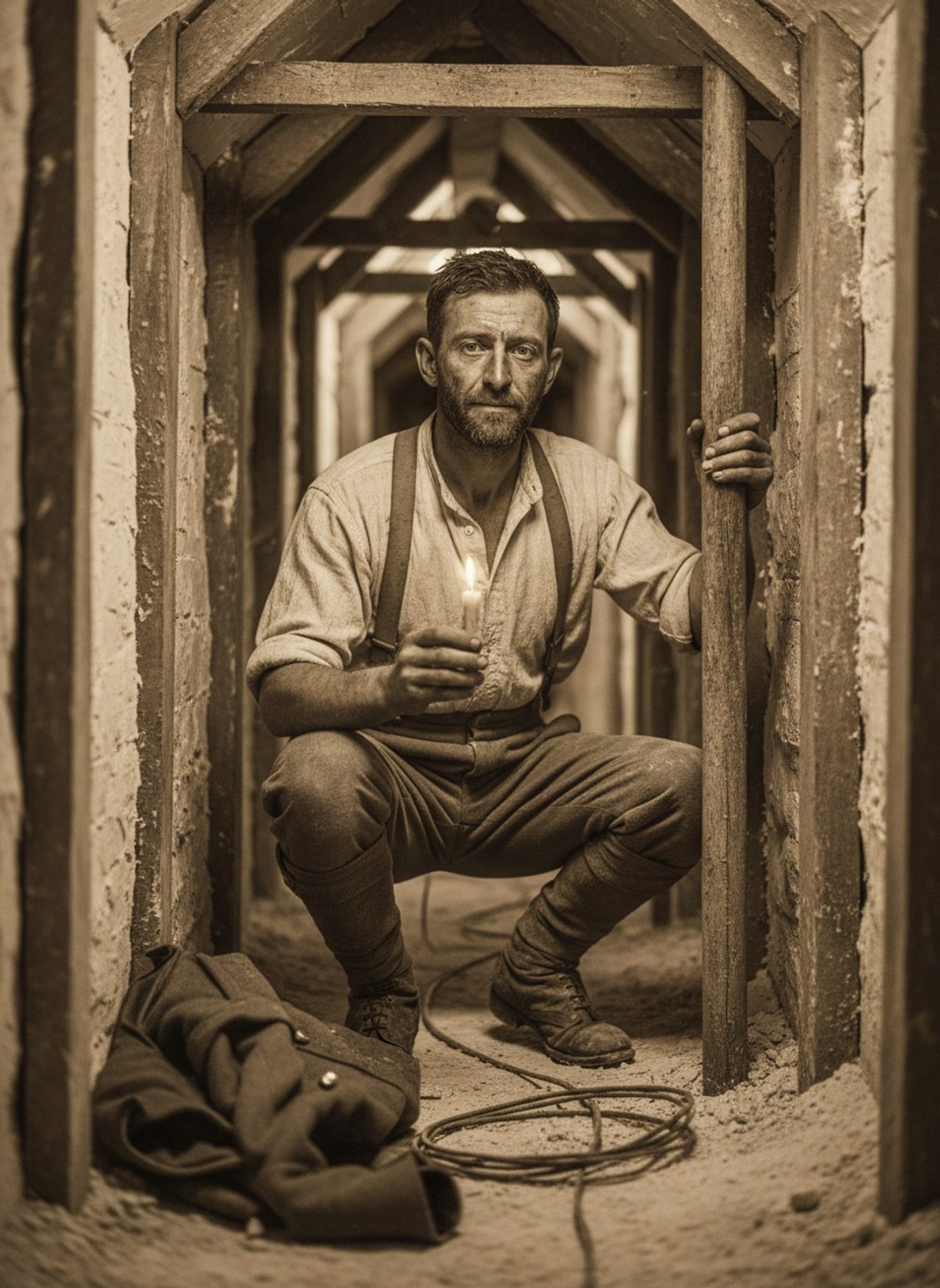
Messines Ridge was simply high ground. But it was what lay beneath that truly made history.
The Silent Miners of No Man’s Land
The year was 1917. Across the devastated landscape of the Western Front, trenches wound like scars through the earth, and above the tumult of war rose a place known as Messines Ridge. Its strategic position was coveted by both sides, but it was beneath this ridge that an extraordinary story unfolded—an underground war of stealth, precision, and perseverance.
The Royal Engineers Tunnelling Companies, often drawn from mining communities back home, were tasked with digging into the darkness of No Man's Land. Their business was brutal and grim: to tunnel under the enemy's entrenched position and plant explosives devastating enough to shatter morale and make way for an infantry advance. These men, equipped with little more than picks, shovels, and hand-driven diggers, transformed warfare's landscape from the sky to beneath the earth.
Working in absolute darkness when even a whisper could betray their presence, these miners lived a life of constant peril. The risk of cave-ins, the stink of gas, the threat of the enemy "counter-mining"—digging their tunnels to intercept and destroy—was the daily norm. Yet, as they chipped away at the earth deep beneath Messines Ridge, they managed what could be considered one of the greatest engineering feats under the worst conditions imaginable.
Read next: The Day a British Stretcher-Bearer Carried 300 Men From the Wire
By 7th June 1917, they had carved out 455 meters of tunnels, weaving careful, tight lines directly under the German fortifications. The path beneath the ridge wasn't merely a stretch of holes in the ground—it was a dark leviathan lying in wait, ready to change the tides of war.
Detonation Day
As dawn broke on June 7th, a quiet anticipation hung over the trenches on both sides of Messines Ridge. For the Allies, this day was acutely anticipated. The men who operated deep in tunnels beneath the earth had spent over a year cautiously and methodically crafting the route to what would be a momentous explosion.
At precisely 3:10 a.m., the fuse ignited. Nineteen massive mines strategically positioned below the ridge roared to life. Within moments, the silence of the early morning was torn apart by what was then the largest explosion ever created by man. The ground lifted, as though a monstrous breath exhaled from the earth's core. The seismic waves were unmistakable, felt as far away as London.
Up above, the German line erupted in chaos. Trenches, artillery emplacements, and men were swallowed whole by the earth, leaving a tumultuous cratered landscape where seconds before had stood fortifications deemed impregnable. Those surviving the initial blast were quickly disoriented, opening a path for the ensuing Allied attack. The ground that had so long favored the German defenses had now, quite literally, shifted under them.
Read next: The Day a British Chaplain Walked Into No Man's Land Alone
The blast's shockwave was not merely a physical force, but a psychological one, heralding a new kind of warfare that employed the slow, creeping might of miners over the spectacle of open military engagements. It was a blow that battered morale and defenses alike, a literal changing of the field.
Echoes and Legacies
The success at Messines Ridge stands as a testament to more than just ingenuity and daring under fire; it marked a turning point in the perception and possibilities of warfare. But it is not just the size of the explosion that echoes down the years. It’s the silent story of those who carved such a massive undertaking into the earth beneath enemy lines.
The tunnellers, often forgotten when recounting the grand narratives of war, deserve a place in history not merely as soldiers, but as craftsmen of destruction, artisans of military might wielded from beneath the soil. Theirs was a technological effort that foreshadowed modern-day engineering, where silent, diligent preparation suddenly unleashes mighty, visible results.
In an era defined by global conflict and the advent of industrialized warfare, the accomplishment at Messines Ridge reminds us of the profound impact that hidden efforts can have on the visible world. Beneath the battered surface of World War I, away from the mainstream tales of sky and sea battles, lay a story of tenacity, precision, and the quiet determination of men who shaped the very earth as a weapon. In remembering the tunnellers, we not only honor their contributions but also recognize the extraordinary interplay of human will, ingenuity, and history beneath our feet.